 Search
 Account
 Discord


Introduction to Clash of Clans Best Townhall 9 Base Layouts
Base design in Clash of Clans is a critical aspect of gameplay, evolving significantly as players progress through different Town Hall levels. At Town Hall 9, players must transition from simple base layouts to more specialized designs that are specifically purposed for farming, trophy pushing, or war. Effective base design involves a deep understanding of various attack strategies, strategic trap placement, and the ability to adapt to the ever-changing meta of the game.
At Town Hall 9, players gain access to a wider variety of troops and strategies, which makes base design more complex and nuanced. Understanding how to protect resources, strategically place the town hall, and counter popular attack strategies becomes paramount. Whether it’s the placement of the dark elixir storage to lure attackers for easy trophies or creating dead zones and layered defenses, each tactic aims to disrupt attacks and protect the village.
Key principles to consider for effective base design:
Base Specialization:
Base design should align with a specific objective, whether it’s farming, trophy pushing, or war. Each type requires a unique layout and defensive strategy to maximize effectiveness.
Farming bases focus on protecting resources, placing storages in well-defended compartments while sacrificing Town Hall placement if needed. Defenses are positioned to slow down attackers rather than prevent a full wipeout, ensuring resources are retained.
Trophy-pushing bases prioritize Town Hall protection, as its destruction determines a player’s ability to gain or lose trophies. Defensive structures are arranged to counter common attacking strategies, with traps and splash damage defenses concentrated around key entry points.
War bases are designed to minimize the number of stars an opponent can earn. They often feature anti-three-star layouts that disrupt funneling, force attackers into traps, and spread out high-value defenses to counter popular attack strategies. Strategic placement of Clan Castle troops and defensive structures can significantly impact the outcome of a war attack.
Dynamic Meta:
The base design is constantly evolving as new attack strategies emerge, forcing players to adapt their layouts to stay effective. Changes in troop balancing, new defense mechanics, and shifting metas influence how bases are structured.
A strong base today may become vulnerable over time as attackers find weaknesses or new troops and spells shift the advantage. Defensive adaptations, such as adjusting trap placements, modifying compartment layouts, or integrating newly introduced defenses, help counter evolving threats.
Players must regularly analyze attack trends, observe successful defenses, and adjust their bases accordingly. Staying ahead of the meta ensures that defenses remain effective against the most commonly used strategies at any given time.
Strategic Defenses:
Effective base design relies on the strategic placement of defenses, traps, and high-hitpoint buildings to control troop movement and maximize defensive efficiency. Proper positioning forces attackers into unfavorable paths, disrupting their strategies and increasing the likelihood of a failed attack.
Defensive structures should be arranged to create overlapping coverage, ensuring key defenses support one another. Splash damage defenses, such as Wizard Towers and Bomb Towers, should be placed to counter swarm units, while single-target defenses like Inferno Towers can target high-hitpoint troops.
Traps play a crucial role in weakening or eliminating enemy forces. Seeking Air Mines and Air Bombs helps counter air attacks, while Giant Bombs and Spring Traps are effective against ground-based assaults. Well-placed traps can disrupt an attack before it gains momentum.
High-hitpoint buildings, such as Clan Castle, Storage units, and Town Hall, can be used to stall enemy troops, forcing them to take longer paths through the base while being targeted by defenses. By carefully designing the layout, players can guide enemy troops into heavily fortified areas, increasing the base’s overall defensive strength.
General Principles for Town Hall 9 Base Design
Evolving Attack Strategies:
At Town Hall 9, attacking strategies become more advanced, making the base design more critical than ever. Simple, all-purpose layouts are no longer effective, as attackers have access to a wider variety of troops and spells. Strategies like Lavaloon, GoHo (Golem-Hog Rider), and Queen Walk-based attacks demand well-structured defenses that can withstand specialized assaults. Bases must now be designed with a clear defensive goal in mind to counter these evolving threats.
Base Specialization:
A successful base at Town Hall 9 must be built for a specific purpose: farming, trophy pushing, or war. Farming bases focus on protecting resources, often sacrificing Town Hall placement to safeguard storages. Trophy bases prioritize defending the Town Hall, making it harder for opponents to earn trophies. War bases aim to prevent attackers from achieving high-star attacks, using anti-three-star layouts to disrupt funneling and counter popular war strategies. Each type requires a different layout approach to maximize its effectiveness.
Constant Adaptation:
The meta of base design is constantly shifting in response to new attack strategies. As certain base layouts become popular, attackers develop counters, forcing defenders to make adjustments. Adapting to these changes involves repositioning defenses, optimizing trap placements, and implementing new defensive structures as they become available. Regularly updating base designs ensures that defenses remain effective against the latest attack strategies, keeping bases well-protected in the ongoing battle between offense and defense.
Farming Base
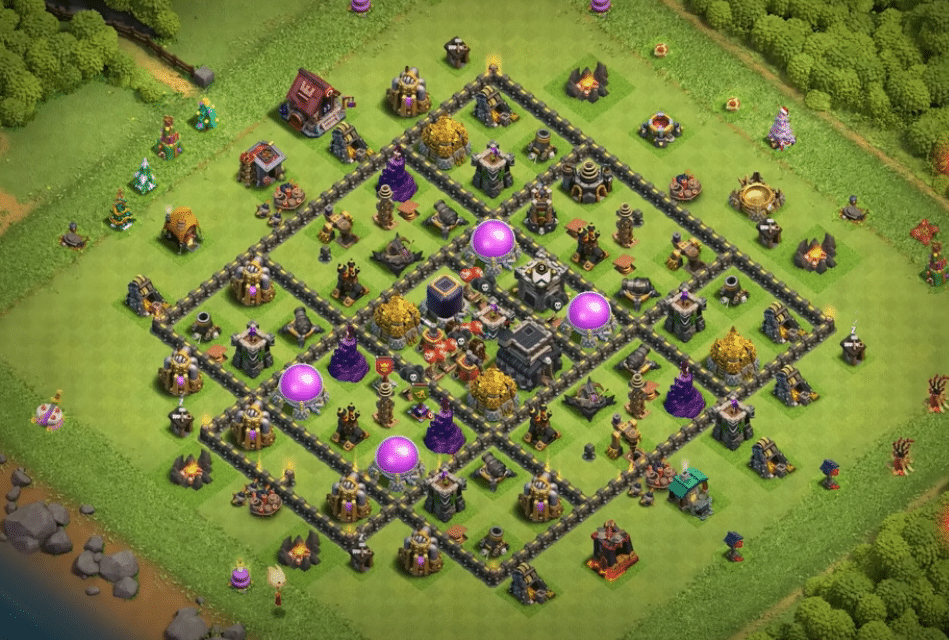
The primary objective of a farming base is to safeguard resources, specifically gold, elixir, and dark elixir, from attackers. Since loot retention is the main focus, the layout must be structured to make resource raids as difficult and costly as possible for opponents.
Storages are the most valuable targets for attackers, making their protection the top priority. They should be placed deep within the base, surrounded by multiple layers of defenses and high-hitpoint buildings to slow down enemy troops. Dark Elixir storage, being the most valuable and hardest to obtain resource, should be given the highest level of protection, often positioned in the core of the base with key defenses such as X-Bows or Inferno Towers nearby.
Defensive structures should be arranged to create a balanced defense that discourages attackers from reaching core resource compartments. Splash damage defenses, such as Wizard Towers and Bomb Towers, help protect storages from swarm attacks, while traps can be strategically placed to disrupt enemy troops before they penetrate key sections of the base. Properly designed farming bases force attackers to spend significant resources and time to reach loot, increasing the chances of them failing or giving up before taking everything.
Trophy Base

Dark Elixir Lure:
At Town Hall 9, a common tactic involves placing the Dark Elixir storage outside the base to bait attackers into a quick one-star victory. Since many players focus on stealing Dark Elixir, this setup increases the chances of them launching a shallow attack that only secures the storage, leaving the rest of the base intact. By sacrificing some Dark Elixir, defenders can prevent a more devastating attack that could result in the loss of multiple stars.
Strategic Town Hall Placement:
Trophy bases often feature an offset Town Hall placement, positioned toward the bottom of the base. This setup forces attackers into difficult choices—either attack from the top, where they may struggle to secure more than one star or attack head-on into the Town Hall, encountering heavy defenses and well-placed traps. Spring Traps, Seeking Air Mines, and Giant Bombs can be positioned in high-traffic areas to weaken enemy troops before they reach key defensive structures.
Adjustability:
A trophy base should be adaptable depending on a player’s goals. If Dark Elixir protection becomes a higher priority, the storage can be moved inside the base, reinforcing it with defenses to make it harder to steal. Regularly adjusting trap placements and tweaking defensive positioning ensures the base remains effective against evolving attack strategies while still serving its primary purpose—securing trophies.
War Base

Countering Popular Attacks:
At Town Hall 9, attackers often rely on strategies such as mass Witches, Dragons, and Hog Riders. A well-designed war base must anticipate these attacks and implement defensive measures to counter them effectively. Compartmentalization, trap placement, and defensive positioning all play a crucial role in weakening enemy troops before they can deal significant damage.
Trap Placement:
Proper trap placement is essential for disrupting attacks and turning battles in favor of the defender. Since attackers often deploy troops in predictable patterns, traps should be positioned in areas where they will have the greatest impact. Spring Traps should be placed along paths where Hog Riders are likely to travel, while Seeking Air Mines should be set near core defenses to target high-value air units.
Anti-Witch Tactics:
Witches rely on swarming bases with Skeletons, making splash damage and trap placement key to countering them. Giant Bombs should be positioned on the outer edges of the base, away from Mortars, to lure Witches over them. When triggered, the bombs will wipe out the Witches and their Skeletons before they can overwhelm defenses. Multi-layered compartments also help disrupt Witch-based attacks by forcing troops to break through walls, slowing their advance and exposing them to splash damage.
Anti-Dragon Tactics:
Dragon attacks depend on overpowering defenses with high-hitpoint air units, making Air Defense protection a priority. Seeking Air Mines should be placed near Air Defenses to weaken Dragons before they reach their targets. Additionally, Air Bombs should be positioned in areas where Dragons tend to group up, dealing damage to multiple units at once. Storages can be used as defensive buffers, placed near Air Defenses to slow down Dragons and keep them in range of defensive fire for as long as possible. Proper positioning of Air Sweepers can also help disrupt Dragon funneling, making it harder for attackers to execute a clean attack.
Key Defensive Strategies
Troop Pathing Manipulation:
Guiding enemy troops into unfavorable positions is a crucial aspect of base design. High-hitpoint buildings, such as storages and the Clan Castle, can be used to redirect attacking forces, forcing them into defensive kill zones. Placing defenses in staggered layers ensures that troops take longer paths, exposing them to sustained damage before they can reach core structures. Open compartments or offset buildings can also disrupt funneling, preventing attackers from easily reaching their intended targets.
Targeted Trap Placement:
Traps are a powerful tool for weakening or eliminating enemy troops when placed correctly. Giant Bombs should be positioned where Hog Riders and other ground troops tend to travel, dealing massive damage upon detonation. Seeking Air Mines are effective against high-hitpoint air units like Dragons and Balloons, while Air Bombs can cripple groups of smaller units such as Minions. Spring Traps should be placed along common pathing routes to remove high-value troops like Hog Riders and Giants from the battlefield.
Defense Prioritization:
Key defensive structures, such as X-Bows, Air Defenses, and Inferno Towers, should be placed strategically to ensure maximum protection. High-hitpoint buildings can serve as shields, absorbing damage and preventing attackers from quickly reaching core defenses. Spreading out splash-damage defenses like Wizard Towers and Bomb Towers helps counter swarm attacks and ensures that attackers cannot eliminate multiple defenses with a single spell or attack wave.
Countering Air and Ground Attacks:
A balanced defense requires preparation against both air and ground attacks. Air Mines and Seeking Air Mines should be placed near core defenses to counter air-based strategies, while Giant Bombs and Spring Traps should be positioned along common ground troop paths. Air Defenses must be well-spaced to avoid being eliminated by Lightning Spells, while Air Sweepers can help disrupt air attacks by pushing back Balloons and Dragons. On the ground, multi-compartment layouts with well-placed splash damage defenses help prevent mass attacks like Witch Spam or Hog Rider rushes from overwhelming the base.
Strategic Considerations
Adapt to the Meta:
Base layouts must evolve alongside the current meta, as new attack strategies emerge and balance changes shift the effectiveness of different tactics. A base that was strong in one season may become vulnerable if attackers develop new ways to exploit its weaknesses. Regularly adjusting layouts, trap placements, and defensive structures ensures that bases remain difficult to break through.
Anticipate Attacker Behavior:
Predicting how an opponent will approach a base is key to designing effective defenses. Attackers often look for weaknesses such as exposed defenses, predictable trap placements, or easy funneling paths. By identifying and addressing these vulnerabilities, a base can force attackers into making difficult choices that reduce the effectiveness of their strategies.
Balance Resource Protection and Defense:
For farming bases, striking a balance between protecting resources and maintaining strong defenses is crucial. While storages should be well-defended, placing all high-value buildings in one compartment can make them an easy target for attackers using splash damage troops or spells. Distributing key defenses while still prioritizing loot protection ensures that attackers struggle to take both resources and stars in a single attack.
Multiple Attack Angles:
A well-structured base forces attackers to approach from multiple sides, preventing them from launching an overwhelming assault from a single direction. Defenses such as Air Defenses, Inferno Towers, and X-Bows should be spread throughout the base to avoid being taken out all at once. This forces attackers to split their forces, making it harder for them to execute a strong push. Additionally, well-placed walls and compartments disrupt troop pathing, increasing the time they spend under defensive fire.
Damage Mitigation:
Effective base design ensures that enemy troops are constantly taking damage while struggling to reach their objectives. Layered defenses create multiple points of resistance, allowing splash damage defenses to weaken attacking forces over time. High-hitpoint buildings act as buffers, delaying troops while defenses deal sustained damage. Traps and defensive structures should be positioned to maximize their impact, disrupting attacker plans and reducing the overall damage inflicted on the base.
Specific Defensive Placements and Tactics
Giant Bomb Placement:
Giant Bombs are crucial for eliminating groups of ground troops, especially those that rely on clustering, like Hog Riders and Witches. Placing these bombs in areas where troops are likely to gather can decimate large portions of an attack force. Common placements include near defensive structures such as Archer Towers or Wizard Towers, where troops tend to congregate during their assault. Additionally, placing Giant Bombs just outside compartments can lure troops into their range, causing substantial damage before they can reach critical areas of the base.
Air Mine Placement:
Air Mines are highly effective against air units like Balloons, Dragons, and Electro Dragons. To maximize their impact, they should be placed near Air Defenses, where attackers are likely to send their air units. This ensures that the Air Mines hit before the attackers reach their target, disrupting the air assault and preventing valuable chain value from Electro Dragons or other splash-damage troops. Careful placement avoids giving attackers extra value from spells like Lightning or Earthquake and helps mitigate air-based threats early in the attack.
Storages as HP Buildings:
Storages serve a dual purpose in base design, not only holding resources but also acting as high-hitpoint barriers that slow down attackers. By placing storages strategically in key compartments, they can act as buffers that delay enemy troops while exposing them to continuous defensive fire. For example, positioning storages in front of important defenses such as the Clan Castle or X-Bows forces attackers to go through them first, giving other defenses more time to inflict damage. This tactic can be especially effective against ground-based armies, which may struggle to get through these barriers without taking significant losses.
Dead Zones:
Dead zones are areas within the base that contain no buildings, forcing attackers to redirect their troops into specific paths. These zones are often placed between defensive compartments or near the core of the base, creating empty spaces where attackers are funneled into traps or concentrated defensive fire. Dead zones work best when combined with traps, such as Spring Traps or Giant Bombs, which catch troops as they are redirected. This forces attackers to take longer paths, exposes them to more damage, and disrupts their attack strategies, increasing the chance of a failed assault.