 Search
 Account
 Discord


- Arcade 01
- Arcade 02
Brawl Stars Basket Case Guide: Overview
Brawl Stars Basket Case is a Basket Brawl map that blends open lanes, scattered cover, and bush-filled areas, creating a dynamic battlefield where strategic positioning and fast-paced gameplay are equally important. The layout encourages both offensive plays and defensive strategies, requiring teams to balance aggression with control. The objective is to score points by throwing the ball into the enemy’s basket, but doing so requires careful coordination, precise passing, and smart movement to outmaneuver opponents.
The Brawl Stars Basket Case map’s open spaces allow for long-range engagements, while bush patches and walls provide cover for ambushes and sneaky plays. Central areas are often heavily contested, as holding control over these zones grants both defensive security and offensive leverage. Brawlers with long-range attacks can dictate the pace of the match from a distance, while assassins and agile brawlers thrive in the tighter spaces, looking for openings to break through enemy defenses.
Success on Brawl Stars Basket Case requires teams to balance defensive stability with aggressive plays, as leaving the basket unguarded can quickly lead to enemy scores. The moving basket adds another layer of complexity, demanding precise timing for shots and making last-second defensive stops even more crucial. The best strategies often involve one player maintaining map control, another pressuring the enemy, and a third player positioning for scoring opportunities.
Choosing the right team composition is vital, with ranged brawlers excelling at controlling lanes, tanky frontliners absorbing damage and holding key positions, and fast-moving brawlers weaving through defenses for quick scores. Coordinating supers at the right moment can also create openings, whether by eliminating defenders or securing the ball for a decisive shot. Teams that adapt quickly, communicate effectively, and execute plays with precision will dominate Brawl Stars Basket Case and secure victory.
Brawl Stars Basket Case Guide: Map Layout
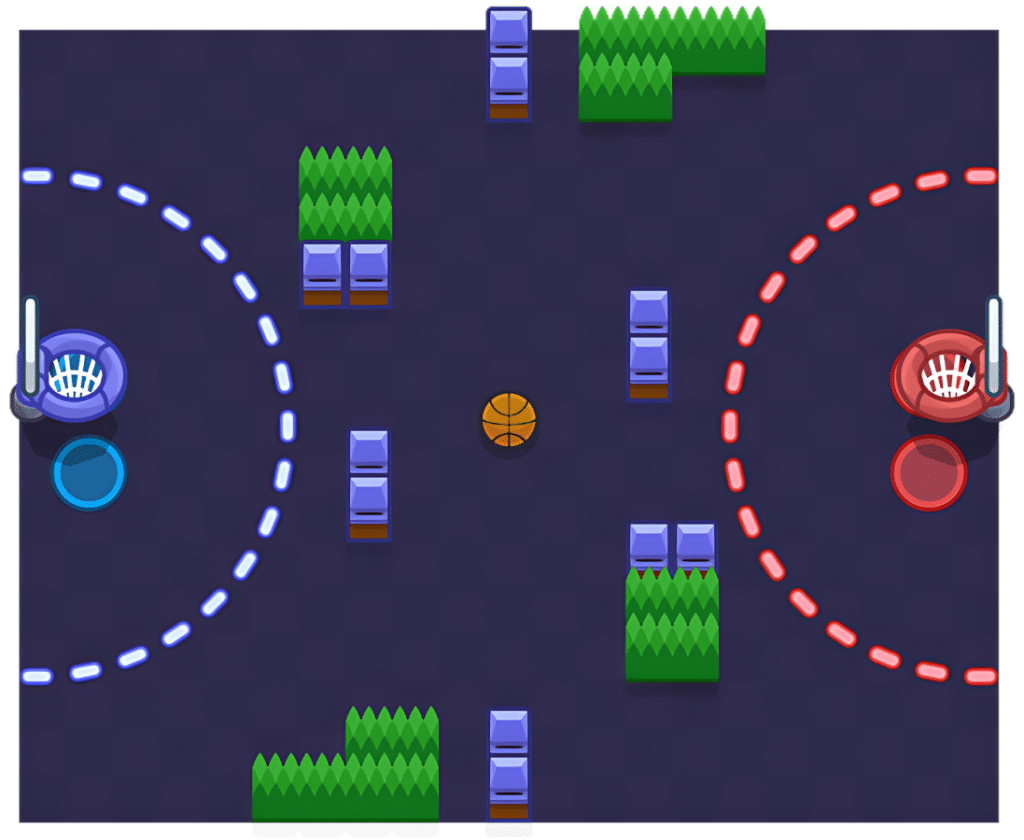
The layout of Brawl Stars Basket Case divides the map into three primary zones: the left lane, the right lane, and the central area, each serving a distinct role in gameplay. The left and right lanes feature a combination of bushes and walls, making them ideal for brawlers who excel at holding ground and applying consistent pressure. These lanes are perfect for brawlers with self-sustain or ambush potential, as they can use cover for surprise attacks or to escape. Controlling these side lanes is crucial for limiting enemy rotations, denying their movement, and creating opportunities for scoring.
The side lanes also act as flanking routes, allowing brawlers to attack from unexpected angles. Brawlers who specialize in mobility or burst damage can capitalize on these routes, either disrupting the enemy’s positioning or forcing them into unfavorable spots. Teams that dominate these areas can control the pace of the game, preventing their opponents from freely advancing or rotating between zones, which is vital for executing successful offensive plays.
The central lane in Brawl Stars Basket Case serves as the map’s focal point, acting as a key area for both offensive pushes and defensive holds. This area offers more open sightlines, making it an ideal spot for ranged brawlers to harass opponents from a distance. Mid-lane brawlers play an essential role in pressuring the enemy’s ball carrier while also supporting their teammates in the side lanes. Balancing between these two objectives is crucial, as it allows the team to control the flow of the game and maintain map control.
Coordination between the lanes is critical to map control and preventing the enemy from setting up scoring opportunities. Successful teams must communicate and rotate effectively to maintain pressure across all areas, ensuring that no zone is left vulnerable. A team that can balance controlling the side lanes with applying pressure in the central area is well-positioned to control the game and create consistent scoring chances. Proper lane management is the key to dominating the Brawl Stars Basket Case map.
Brawl Stars Basket Case Guide: Team Compositions
In Brawl Stars Basket, team compositions that balance offensive power, defense, and utility are essential for success. A well-rounded team can control the map, disrupt enemy plans, and create opportunities for scoring. Whether it’s tanky brawlers absorbing damage, support brawlers providing sustain, or damage-dealing brawlers applying pressure from afar, each role plays a crucial part in executing a successful strategy. Understanding how to complement each other’s strengths and manage map control can make all the difference in securing a win.
Tanky Brawlers and Crowd Control

Successful team compositions often rely on a solid front line of tanky brawlers or those with crowd control (CC) abilities to dominate key areas and create space for teammates. Brawlers like Frank, Buster and Ash are ideal for this role, as they can absorb significant damage while disrupting enemy formations. Their bulk and CC abilities force the opposing team to expend resources and reposition frequently, which creates windows of opportunity for their allies to capitalize on. Whether it’s through the stuns from Frank’s Super or Buster’s shield, these brawlers effectively break up enemy coordination and control the flow of the game, allowing their team to push forward without taking excessive damage.
Support Brawlers

Support brawlers are crucial for maintaining momentum and sustainability during extended engagements. Healers like Byron and Pam keep teammates in fighting shape, while also mitigating damage to buy more time for map control. Utility brawlers like Gene provide essential crowd control and vision, with Gene’s Super pulling enemies and Tara’s Super disorienting foes. These brawlers excel in defensive holds, where their ability to disrupt enemy positioning is key to maintaining control and setting up scoring opportunities.
Ranged Damage Dealers

Damage-dealing brawlers with range and burst potential are vital on Brawl Stars Basket, especially in the central lane where open sightlines allow for effective long-range harassment. Brawlers like Belle, Piper, and Brock can apply consistent pressure from a distance, weakening enemies before they reach key areas. Their ranged attacks force opponents to play more defensively, focusing on avoiding damage rather than advancing. This opens up opportunities for teammates to push forward, disrupt enemy defenses, and set up scoring chances. These brawlers are also effective at taking out enemy ball carriers or defensive brawlers controlling the center. Their flexibility in both offense and defense makes them valuable, particularly when breaking through tough defenses or during stalemates.
Balancing Offense, Defense, and Utility for Team Success
For a team to succeed on Brawl Stars Basket, a balanced composition that blends offense, defense, and utility is crucial. Tanky brawlers anchor the frontline, holding key areas and absorbing damage. Support brawlers provide sustain and create opportunities through healing or crowd control. Ranged damage dealers apply consistent pressure from a distance, weakening the enemy and creating space for their team. A composition that effectively combines these roles can control the map, outlast enemy pushes, and generate scoring chances. Successful communication, coordination, and strategic rotations are key to victory, making it essential to have the right balance of power, sustain, and utility on the battlefield.
Brawl Stars Basket Case Guide: Game Mode

In Brawl Stars Basket Case, the Basket Brawl game mode is an exciting, fast-paced, team-based competition where the objective is to score by getting the ball into the enemy team’s basket. The map is divided into three lanes: the central lane provides a direct route to the basket, while the left and right lanes offer opportunities for flanking and strategic positioning. Controlling these lanes and maintaining map dominance is essential for success in Basket Brawl.
The game begins with both teams vying for control of the central lane, where the ball spawns. In Brawl Stars Basket Case, the ball becomes a critical object that teams must secure and carry toward the enemy’s basket. Once a team grabs the ball, they must coordinate their movements to avoid enemy attacks while navigating through the lanes. The ball can be passed between teammates or intercepted by the opposing team, leading to fast-paced, strategic battles for control.
In Basket Brawl, teamwork is key to both offensive and defensive strategies. Tanky brawlers in Brawl Stars Basket Case serve as anchors, absorbing damage and protecting the ball carrier. Support brawlers heal their teammates and provide crowd control, while damage-dealing brawlers focus on pressuring the enemy from a distance. The coordination between these roles is vital for success, as each lane offers different advantages and challenges that can shift the game’s momentum.
Winning Basket Brawl in Brawl Stars Basket Case requires precise timing, communication, and coordination. Teams must balance offense and defense, constantly rotating and reacting to the flow of the game. Controlling the side lanes while pressuring the central lane can create the perfect opportunity to score. The first team to reach the set score limit wins, but the dynamic nature of Basket Brawl means that the game can change rapidly, making each play a critical moment for victory.
Brawl Stars Basket Case Guide: Control and Map Domination
Establishing control of Brawl Stars Basket Case requires a careful balance of aggression and patience. At the start of the match, securing the side lanes early is crucial, as it limits enemy movement and denies them access to critical flanking routes. By taking control of these lanes, your team can disrupt the opponent’s plans and force them into more predictable paths. Brawlers with bush-checking abilities or vision gadgets, such as those with area-detection Supers, are especially important for maintaining control. These brawlers can prevent surprise ambushes, ensuring the team has clear sightlines across the map and can act proactively rather than reactively.
Controlling the central lane is key to dictating the flow of the game. A team that dominates this lane can force the enemy into a defensive posture, limiting their options and putting pressure on their ability to make effective plays. The central lane serves as the main route to the basket, so maintaining control here allows your team to push the enemy back and keep them from positioning themselves for effective counterattacks. By controlling this area, your team can shape the pace of the game and force the opposing team to respond to your movements.
Maintaining pressure across all lanes is another critical element of map domination. When your team is applying consistent pressure in multiple areas, it creates opportunities for scoring and forces the enemy to spread their defenses thin. Coordinated pinch attacks between lanes can overwhelm defenders, disrupting their positioning and giving the ball carrier a clear path to the basket. Teams that coordinate attacks from different angles and sustain pressure on all lanes simultaneously often catch their opponents off guard, making it difficult for them to defend effectively.
Ultimately, teams that prioritize consistent lane pressure while denying the enemy access to key areas will find themselves in a stronger position to dominate the map. A combination of strategic lane control, bush-checking, and effective coordination across all lanes allows your team to force the enemy into defensive play and capitalize on any openings. By maintaining constant control and dictating the flow of the match, your team can stay ahead and create ample opportunities for scoring, ultimately leading to victory in Brawl Stars Basket Case.
Brawl Stars Basket Case Guide: Strategy and Tips
Patience and coordination are essential when pushing forward in Brawl Stars Basket Case. Rushing the ball without proper support often leads to turnovers, leaving the team vulnerable to counterattacks. Rather than pushing aggressively from the start, players should focus on controlling the map and wearing down enemy defenses. Communication is key for coordinating pushes—one player should carry the ball while others provide cover, disrupt enemy defenders, and control key zones. This teamwork prevents the ball carrier from being overwhelmed and ensures that the team can push forward more safely.
Super abilities and gadgets play a vital role in breaking defensive holds and creating scoring opportunities. Area-denial gadgets can block enemy escape routes, while crowd control Supers can isolate defenders and create gaps in their formation. Timing these abilities during coordinated team pushes is crucial to maximize their impact. Properly timed abilities can disrupt the enemy’s strategy, leaving them exposed and allowing your team to capitalize on the opening and score more effectively.
Adapting to the flow of the match is critical as the score fluctuates. Teams must recognize when to play defensively or aggressively based on the game’s progression. If the team is ahead, focusing on defense and denying the enemy access to key areas can help preserve the lead. On the other hand, if behind, the team should adopt a more aggressive, high-pressure approach to force errors from the opposition. Striking the right balance between offensive and defensive plays is key to maintaining map control and setting up scoring chances.
Ultimately, teams that balance calculated aggression with defensive discipline are more likely to succeed in Brawl Stars Basket Case. By focusing on map control, timing abilities strategically, and adapting to the match’s ebb and flow, teams can avoid unnecessary risks while creating consistent scoring opportunities. Communication, coordination, and adaptability are the keys to securing victories in this high-pressure game mode.
Brawl Stars Basket Case Guide: Conclusion
Brawl Stars Basket Case is a game mode that rewards teams with strong coordination, strategic map control, and adaptability. Success in this mode hinges on how well teams work together to dominate key areas and execute effective plays. The map’s layout, featuring open lanes, scattered cover, and bush-filled zones, offers a variety of tactical advantages that allow a broad range of brawlers to shine. Whether you’re playing as a tanky frontline brawler, a ranged damage dealer, or a support character, versatility is a key factor for victory. Teams that can adapt to the map’s challenges and take advantage of these diverse areas will have a significant advantage.
One of the most crucial elements in Brawl Stars Basket Case is maintaining constant pressure across all lanes. By controlling the central area and the side lanes, teams can create openings, disrupt the enemy’s rotations, and prevent them from effectively executing their own plays. Utilizing crowd control abilities is another vital component in gaining map control and setting up successful offensive pushes. Whether it’s through stuns, pulls, or area denial, these abilities can cripple the enemy’s positioning and open up scoring opportunities.
Executing well-timed pushes is equally important, as teams must balance aggression with caution. Knowing when to push forward with the ball or when to hold back and regroup can make all the difference in a match. A coordinated push, where teammates work together to clear the path for the ball carrier, ensures the team can reach the enemy basket without losing possession to a counterattack. This requires precise timing and communication to avoid turnovers and eliminate the risk of giving the opposing team an opportunity to counter.
Ultimately, Brawl Stars Basket Case rewards teams that excel in both offensive plays and defensive holds. Mastering the delicate balance between pressure and control is key to dominating this game mode. Teams that can execute their strategies with precision, adapt to the flow of the match, and communicate effectively will be well-positioned to outmaneuver opponents and secure victory. By maintaining solid map control and working in perfect harmony, players can maximize their chances of success in Brawl Stars Basket Case and dominate the competition.

