 Search
 Account
 Discord


Introduction to Runes
Runes are essential components in Summoners War: Sky Arena, functioning as powerful tools to enhance your monsters’ abilities. They are specialized equipment that increase various stats, such as health points (HP), attack power (ATK), defense (DEF), accuracy, and speed (SPD), among others. These enhancements can make a significant difference in battle performance, often outweighing the raw strength of a monster. A well-runed monster can outperform a stronger one with poor rune synergy, making rune strategy a core element of gameplay.
The effectiveness of runes is not just in their individual power, but in how they are combined to form sets that activate additional bonuses. This makes understanding the intricacies of runes essential, which is where a Summoners War Rune Guide becomes invaluable for players looking to maximize their monsters’ potential.
Each monster can be equipped with six runes, and depending on the rune type, equipping two or four of the same kind will activate set bonuses. For example, two Energy runes will grant +15% HP, while four Fatal runes provide a +35% ATK boost. This system enables customization and strategic planning, allowing you to tailor rune builds to the specific role of a monster—whether it’s a tank, damage dealer, or support unit. Runes are obtained from different scenarios, dungeons, and special areas, and are categorized by their set effects and origins.
Some runes, such as Swift (+25% SPD), Blade (+12% CRI Rate), and Focus (+20% Accuracy), are useful for enhancing offensive roles. Others like Guard (+15% DEF), Endure (+20% Resistance), and Shield (generates an ally shield) are geared toward defensive or support builds. Unique sets like Violent offer a 22% chance for an extra turn, while Will grants immunity to harmful effects for one turn at the start of the battle.
There are also advanced sets exclusive to specific dungeons, such as Rage (+40% Critical Damage) from Necropolis and Vampire (+35% life drain) for sustainability. Rift Beast-specific sets—Fight, Determination, Enhance, Accuracy, and Tolerance—can be stacked and enhance team stats in elemental raids. Specialized runes like Seal and Intangible are designed for unique bosses and require tactical deployment in high-level content.
Mastering rune selection, placement, and enhancement is key to progressing in both PvE and PvP. By understanding each rune set’s function and origin, players can build stronger, more efficient teams tailored to any challenge in the game.
Understanding Rune Basics

To truly master Summoners War: Sky Arena, it’s essential to understand the basic mechanics of runes, which are the most impactful elements in building strong and efficient monsters. Every monster has six dedicated rune slots, numbered from 1 to 6, and each rune you equip will occupy one of these specific slots. These runes come with a main stat, which is the primary bonus the rune provides, and up to four substats that add secondary benefits.
Rune slots 1, 3, and 5 always have fixed main stats—Attack for slot 1, Defense for slot 3, and HP for slot 5. In contrast, slots 2, 4, and 6 can feature a variety of main stats, including percentage-based stats like ATK%, DEF%, or HP%, which are generally preferred due to their scaling value. Speed is a unique and highly valuable main stat that only appears on slot 2, as SPD% does not exist.
Substats vary depending on the rune’s rarity and can significantly influence a rune’s value. Substats that align well with the rune’s main stat and the monster’s role—such as Critical Rate, Critical Damage, and ATK% on an attacker—are desirable. On the other hand, mismatched combinations, like a Fatal rune with DEF% main stat and support-type substats, are typically sold.
Runes are categorized into five rarities based on the number and quality of substats: Common (White), Magic (Green), Rare (Blue), Hero (Purple), and Legendary (Orange). Higher rarity runes start with more substats and offer better potential when upgraded. Legendary runes always include an innate stat, also called a prefix, which appears beneath the main stat. This innate stat is determined when the rune drops and cannot be modified or enhanced, but it prevents the same stat from appearing in the substats.
Rune upgrades, done using Mana Stones, increase rune stats and potentially unlock or improve substats. Runes can be upgraded to +15, with stat increases occurring at +3, +6, +9, and +12. When a rune has fewer than four substats, a new one is added at those milestones; otherwise, an existing substat is enhanced. Legendary runes can achieve a powerful effect known as a quad roll, where all upgrades enhance a single substat, often resulting in highly efficient runes. Each rune’s upgrade potential is influenced by its rarity, and substats have a maximum value per upgrade. The main stat gains a 20% boost at level +15.
A useful method for evaluating runes is by counting “hits”, where each hit represents one instance of a maximum substat roll. Percentage-based substats like ATK%, HP%, or DEF% max out at +8% per hit, while Critical Rate and Speed cap at +6%. Flat stats are generally excluded from this calculation due to their limited impact. This hit-counting system provides a fast and practical way to assess rune efficiency and decide whether to keep or sell them.
As you accumulate runes, it becomes vital to manage your inventory by selling those that aren’t worth investing in. Typically, flat main stat runes on slots 2, 4, and 6 are sold unless the slot 2 rune has Speed as its main stat. Runes of lower rarity, especially Magic or below without desirable substats like Speed, are also frequently discarded. However, high-tier runes such as six-star Legendary runes are often kept for later optimization, even if their initial substats are poor, as they can be improved using Reappraisal Stones, which allow you to reroll the substats.
Mastering the basic principles of rune slots, stats, rarity, set bonuses, upgrades, and evaluation methods is key to optimizing your monsters and making progress in all areas of Summoners War. With this foundation, you can begin building rune setups that suit your monsters’ roles and unlock their full potential in both PvE and PvP content.
Identifying Good Runes

Identifying good runes in Summoners War: Sky Arena is a key part of building powerful teams and progressing through the game. A good rune is not just defined by its stats in isolation, but by how well it synergizes with the monster it’s meant for. This includes a careful evaluation of the rune’s main stat, substats, set bonus, and how they all work together to support the monster’s role.
Synergy between the main stat and substats is essential. For example, a Fatal rune, which provides an attack bonus, is most effective when it includes substats that further enhance offensive capabilities, such as ATK%, Critical Rate, and Critical Damage. On the other hand, substats like DEF% or Resistance% on a damage-dealing rune would be less beneficial. Conversely, support-focused rune sets such as Energy or Will perform best with defensive or utility substats like HP%, DEF%, Speed, Accuracy%, and Resistance%, which align with their intended use on tank or support monsters.
The monster’s role must also be taken into account. A monster with AoE skills benefits from Despair runes, which have a chance to stun enemies when using AoE abilities. However, placing Despair runes on single-target units is typically ineffective. Matching a rune’s effect and stats with the specific function of the monster ensures better performance in combat.
For rune slots 2, 4, and 6, percentage-based main stats such as ATK%, DEF%, HP%, Crit Rate%, Crit Damage%, Resistance%, and Accuracy% are generally preferred. These stats scale better with a monster’s growth and provide more significant advantages. The exception is slot 2, where Speed is a unique and highly valuable main stat, as there is no percentage version of Speed. Even a rune with weaker substats can still be worthwhile if it has Speed as the main stat in slot 2, especially in earlier stages of the game.
Speed is widely regarded as one of the most important stats in the game. Faster monsters act more frequently, allowing them to control the battle flow through quicker debuff applications, healing, or damage. Substats with Speed are valuable for nearly every monster type, making them a high priority when evaluating rune quality.
Rune rarity plays a major role in determining potential. Higher-rarity runes begin with more substats and allow for more chances at favorable stat rolls. Legendary six-star runes are especially prized due to their four substats and innate stat, giving them the highest potential. Even if a Legendary rune’s initial stats are poor, it can often be improved later with reappraisal, making it worth keeping.
When powering up runes, the quality of the substat rolls becomes critical. A rune that repeatedly enhances a strong substat like Speed, Critical Rate, or a key percentage-based stat can become extremely effective. The concept of a “quad roll” refers to all four upgrades going into the same substat, which can create very high values. Runes that start with high base substats also have better potential since each roll can significantly boost those values.
Innate stats, which are separate from substats and cannot be upgraded, offer additional value. A useful innate stat that complements the rune’s other properties can increase the rune’s overall efficiency. Legendary runes always include an innate stat, adding to their appeal.
In the early to mid-game, it’s best to focus on assembling complete sets with the right main stats, rather than obsessing over substat perfection. Having a full set of 5-star or 6-star runes with useful main stats—especially Speed, HP%, ATK%, or DEF%—is a good foundation for early progression. As your account matures and you gain access to better farming areas like Giants B10, your rune quality standards should rise accordingly.
To manage inventory effectively, it’s important to know when to sell runes. Flat main stat runes on slots 2, 4, and 6 should be sold immediately, unless the main stat is Speed in slot 2. Once you can farm higher-level dungeons, Magic-grade runes lose their value and should be sold regardless of their substats. Five-star Hero runes without a Speed substat typically aren’t worth keeping either. Runes with substats that don’t synergize with the main stat or the intended monster’s role should also be sold, unless the rune is a Legendary six-star candidate for future reappraisal. Runes that contain both Resistance% and Accuracy% substats are often avoided as these stats are rarely needed on the same monster.
By applying these principles, you can reliably identify runes that are worth keeping and investing in. With experience, your ability to recognize high-potential runes will improve, and your rune quality will naturally progress alongside your monsters and overall game performance.
Farming Runes
Farming runes is one of the most important long-term activities in Summoners War: Sky Arena. Strengthening your monsters through better rune sets is the primary way to increase their effectiveness and progress through the game’s many challenges. Understanding where to farm runes, which sets to prioritize, and how to manage your rune inventory is essential to building a strong account.

In the early game, players obtain runes primarily by completing scenario stages across the adventure map. These stages drop runes of different star levels depending on the difficulty: Normal yields mostly 1–2★ runes, Hard gives 2–3★, and Hell difficulty can provide 3–5★ runes. However, these are only a temporary stepping stone. The core goal early on is to build a team capable of farming Giant’s Keep, which is the main source of foundational rune sets.
Giant’s Keep drops Swift, Fatal, Blade, Despair, and Energy rune sets. These are versatile and useful across a wide range of PvE and PvP content. Swift runes, in particular, are essential for building fast support units, while Despair runes are valuable for monsters with AoE skills due to their chance to stun. Blade and Fatal are ideal for early damage dealers, and Energy provides survivability. Among these, Swift and Despair are especially impactful and often remain relevant even into late-game content.
Once your team can reliably clear Giant’s Keep B10, the next progression step is Dragon’s Lair. This dungeon drops Violent, Revenge, Focus, Guard, Shield, and Endure runes. Violent runes are especially valuable for many monsters due to their ability to grant additional turns, offering both damage and utility advantages. However, Dragon’s Lair is typically better suited for players with a solid foundation of runes and team synergy, as it is more difficult to clear consistently in the early stages.
Necropolis is the third primary dungeon and unlocks access to Rage, Will, Nemesis, Vampire, and Destroy rune sets. These sets are most relevant for late-game content and advanced team strategies. Rage runes significantly boost Critical Damage, making them ideal for nukers. Will runes provide immunity on the first turn, which is crucial for many PvP scenarios. Nemesis, Vampire, and Destroy all offer strategic value for specific monsters and content. Necropolis generally requires a team with multi-hit skills and is not a recommended focus until players have already farmed solid Violent sets from Dragon’s Lair.
During mid-game progression, most players will cycle between Giant’s Keep, Dragon’s Lair, and eventually Necropolis, depending on which rune sets are needed. Farming B10 difficulty in each dungeon provides the best chance of acquiring 6-star Hero or Legendary runes, which are necessary for top-tier builds.
Outside the main dungeons, runes can also be obtained from several other sources. The Magic Shop refreshes periodically and can offer high-quality runes for Mana Stones, especially as your account level increases. The Dimensional Hole offers occasional rune rewards and is a late-game area tied to secondary awakenings. In-game events and daily missions frequently provide rune rewards as well, and are worth participating in consistently. Grindstones, which enhance rune substats, are earned from Rift of Worlds content and become increasingly important for rune optimization as you enter the late game.
To farm efficiently, focus on developing a consistent team for Giant’s Keep B10 as your first major milestone. Understanding which rune sets benefit your team compositions most will help guide your farming priorities. Aim to acquire 6-star runes as often as possible, as they have higher stat ceilings than lower star runes. Carefully manage your rune inventory to avoid clogging it with low-quality or flat-stat runes. When powering up runes, evaluate their potential by upgrading to +6 or +9 before committing further resources. Mana Stone efficiency is also important—removing and powering up runes comes with costs, so plan your rune builds with intention.
As a general guideline, start by farming scenario maps for basic runes, then shift your focus to Giant’s Keep B10 for essential early-to-mid game sets. Once your GB10 team is solid, begin transitioning into Dragon’s Lair for Violent runes, and eventually Necropolis when your account can handle it. Throughout all stages, continue to evaluate, upgrade, and replace your runes to steadily improve your monsters’ performance.
Farming runes is a continuous process that rewards consistency and strategic decision-making. With time and effort, your rune quality will improve, unlocking the potential of your monsters and enabling you to clear increasingly difficult content.
Powering Up and Enhancing Runes
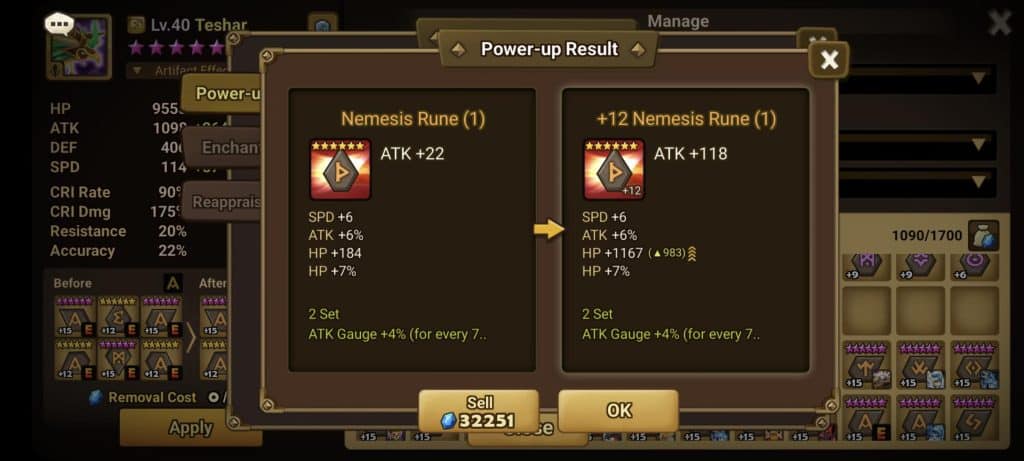
Powering up and enhancing runes is an essential part of optimizing your monsters in Summoners War: Sky Arena. Once runes are acquired, they can be strengthened through the use of Mana Stones, which increases their effectiveness in both main and substats. Understanding how the upgrade process works, when to invest, and how to further enhance runes will help you maximize your team’s potential.
Powering up runes increases the main stat and either unlocks or improves substats. This process consumes Mana Stones, with the cost scaling higher as the rune level increases. The success rate for powering up also drops at higher levels. From +1 to +3, the upgrade is guaranteed, but from +4 onward, there is a chance of failure, requiring multiple attempts and more Mana Stones. Runes can be powered up to a maximum of +15, at which point the main stat receives a final boost, typically around 20% more than the previous level.
| Rarity (when acquired) | +0 | +3 | +6 | +9 | +12 | +15 |
| Normal | 0 | 1 | 2 | 3 | 4 | 4 |
| Magic | 1 | 1 | 2 | 3 | 4 | 4 |
| Rare | 2 | 2 | 2 | 3 | 4 | 4 |
| Hero | 3 | 3 | 3 | 3 | 4 | 4 |
| Legendary | 4 | 4 | 4 | 4 | 4 | 4 |
Runes are classified by rarity: Common (White), Magic (Green), Rare (Blue), Hero (Purple), and Legendary (Orange). Rarer runes come with more starting substats, making them more efficient to power up. A Legendary rune has four substats from the start, while a Hero rune begins with three. Lower-rarity runes gain substats as they are powered up at levels 3, 6, 9, and 12, with a maximum of four substats in total. Additionally, some runes come with an innate stat, separate from the main and substats, which cannot be changed but also cannot be enhanced.

To evaluate a rune’s potential, it’s often best to power it up to +6 initially to see which substats are enhanced. This gives an early indication of its value. In some cases, taking a rune to +9 offers a clearer picture before deciding whether to continue investing. Prioritize runes that roll into synergistic substats—such as Crit Rate, Crit Damage, Speed, and HP%—depending on the role of the monster you plan to use it on. Speed is especially important, as it impacts turn order and combat flow, so runes that gain Speed through substat enhancements are particularly valuable.
Beyond basic powering up, runes can be further enhanced using Grindstones, Enchanted Gems, and Reappraisal Stones. Grindstones improve existing substats and are specific to both rune sets and stat types. For example, a Violent grindstone will only work on Violent runes, and a Speed grindstone will only boost the Speed substat. Grindstones come in different grades—Magic, Rare, Hero, and Legendary—with higher grades offering greater boosts. Only flat stats and percentage-based stats (such as HP%, ATK%, DEF%, and Speed) can be enhanced this way.

Enchanted Gems allow you to replace one of a rune’s substats with a new one, providing a method for customizing runes that have one or two weak stats but strong overall potential. Like grindstones, enchanted gems are set-specific and have different grades that determine the strength of the new substat. Once a stat is replaced, that slot can no longer be upgraded with grindstones, so careful planning is important.

Reappraisal Stones are used exclusively on 6-star Legendary runes. When applied, they reroll all four substats on the rune, providing a new set of random stats. After the reroll, you can choose to keep either the new or original set. The rune’s level and upgrades are retained regardless of which substats you select. Reappraisal Stones are powerful tools for transforming high-grade runes that have poor or mismatched substats into highly desirable ones.

Rune enhancement also involves understanding substat rolls. A “quad roll” happens when all four stat upgrades land on the same substat, dramatically increasing its value. These runes are rare and can be extremely powerful when the boosted substat is something impactful, like Speed or Crit Rate. Substats have predefined ranges for each roll, and there are limits to how much a single stat can increase per roll. For example, if a rune has an initial substat of +8% ATK, each additional roll into that stat can only add up to +8% more per upgrade. Also, initial substats like Speed cannot exceed +6 for a single roll, and +10 Speed as an initial stat is not possible.
By carefully choosing which runes to upgrade and how to enhance them, you can build powerful rune sets that elevate your monsters’ performance across all areas of the game. Efficient use of Mana Stones, thoughtful evaluation, and smart enhancement choices will help you make the most of every rune and push your account toward higher-level content.
Rune Management: Keeping or Selling
Efficient rune management is essential in Summoners War: Sky Arena for maximizing monster performance and maintaining a clean, functional inventory. As you progress through the game, your criteria for keeping or selling runes should evolve based on your rune quality needs and the monsters you’re building.
When evaluating whether to keep or sell a rune, start by examining substat synergy. A rune is more valuable when its substats complement its main stat, rune type, and the role of the monster it’s intended for. For example, a Fatal rune is most effective with ATK% as the main stat and offensive substats like Crit Rate or Crit Damage. Conversely, a Fatal rune with a DEF% main stat and support-oriented substats is generally not worth keeping. Rune rarity and star level are also key factors—6-star runes offer the highest stat ceilings, while Hero and Legendary rarities begin with more substats, making them more viable for long-term use.

Main stat selection is critical, especially for rune slots 2, 4, and 6. On these slots, percentage-based main stats like HP%, ATK%, DEF%, Crit Rate%, and Crit Damage% provide scaling benefits based on the monster’s base stats. The notable exception is slot 2, where Speed is a highly sought-after main stat. Flat stat runes on slots 2, 4, and 6 are typically sold, as they offer minimal scaling and are outclassed by percentage-based options.
Speed is one of the most important stats in the game, and runes with Speed substats are highly valuable across all stages of progression. Even in early game content, having the Speed advantage can determine the outcome of a battle. Substat rolls during rune upgrades also significantly impact value—multiple upgrades into a single desirable substat, such as Speed or Crit Rate, can make a rune much stronger, especially if it results in a high roll distribution.
There are specific scenarios where runes can be sold immediately, particularly during the mid-game when farming Giant’s Keep B10. Flat stat runes on slots 2, 4, and 6 should be sold, with the only exception being slot 2 Speed main stat runes. Magic-grade 5- or 6-star runes, even with decent substats, generally do not offer enough potential and are safe to sell.
Hero-grade 5-star runes without a Speed substat are also not worth keeping. Runes with mismatched substats that do not complement their main stat or set type should be discarded unless they are 6-star Legendary runes, which may be candidates for reappraisal. Runes that only offer Resistance% and Accuracy% substats are usually not useful unless tailored for very specific support builds.
Rune management varies by game progression. In the beginner stage, you may need to keep lower rarity runes temporarily, prioritizing any rune that offers a useful main stat. As you build your first core teams, equipping monsters with full sets of 4-star or higher runes takes priority. In early to mid-game, after establishing a GB10 farming team, the focus shifts to acquiring 6-star runes with high-value percentage-based main stats and complementary substats like Speed, Crit Rate, or ATK%.

During mid to late-game, standards become more refined, with most players only keeping 6-star Hero and Legendary runes with excellent substat rolls or strong innate stats for later optimization. Legendary runes with poor substats may still be worth keeping if they offer good main stats, set types, or innate stats, as they can be improved through reappraisal.
Rune efficiency becomes a helpful tool for assessing potential. A basic “counting hits” method allows quick estimation—each substat has a maximum possible roll value, and a rune’s efficiency can be approximated by comparing its current values to those maximums. While some players use more detailed formulas or third-party optimizers, a rough estimate based on substat quantity and quality is usually sufficient. However, synergy between main and substats remains more important than pure efficiency; a rune with excellent efficiency but mismatched stats will not perform well in practice.
Advanced rune management involves considering the rune’s role in specific content areas. Different rune sets shine in different game modes—Violent for PvP and PvE versatility, Despair for crowd control in Trial of Ascension, and Rage for maximizing damage in dungeons like Necropolis. It’s often acceptable to keep a suboptimal rune if it completes a valuable set for a particular monster or game mode. Innate stats, also known as prefixes, provide an additional stat that does not change and cannot be powered up. Runes with strong innate stats like Speed or Crit Damage are more desirable and may be kept even with weaker substats.
Reappraisal Stones are best used on 6-star Legendary runes with promising potential—those with useful main stats, good rune sets, and ideally a strong innate stat. These stones allow you to reroll all substats while keeping the rune’s level and enhancements. Grindstones and Enchanted Gems provide further customization, with grindstones improving existing substats and gems allowing for replacement of one substat entirely. Runes with a mix of good and bad substats can often be salvaged and made powerful with the right upgrades, especially in the late game.
For more streamlined management, consider using in-game or third-party tools that automate rune selling based on custom rules. These tools allow you to set filters for rune rarity, star level, main and substats, and even specific stat thresholds. Automating basic rune sorting and selling frees up time for more meaningful decision-making and helps maintain a lean, high-quality rune inventory.
By following these principles and adjusting your evaluation criteria as your account matures, you can make better decisions about which runes to keep, sell, or invest in. Regularly reviewing your inventory and removing outdated or inefficient runes ensures that your monsters are always equipped with the best gear available, keeping your progression steady and your strategies effective.
Advanced Rune Concepts
As you advance in Summoners War: Sky Arena, mastering advanced rune concepts becomes essential for optimizing your monster builds and competing in more challenging content. While early game rune decisions may focus on basic stat types and set bonuses, advanced gameplay demands deeper evaluation of rune quality, efficiency, and customization potential.

Rune efficiency is a key metric used to evaluate how close a rune’s current substats are to the best possible version of that rune. A perfect rune is considered 100% efficient, meaning it has all maximum substat values possible for its rarity and level. One simple way to estimate efficiency is the “counting hits” method—each desirable substat rolled to its maximum value counts as one hit, such as +8% for percentage stats or +6 for Speed and Crit Rate. By tallying the current and potential hits on a rune, you can quickly determine whether it’s worth keeping or investing in.
The synergy between the substats, the main stat, the rune set, and the monster’s role is far more important. A rune with excellent numbers but irrelevant stats will still underperform compared to a slightly less efficient rune with perfect synergy.
Reappraisal Stones are powerful resources used exclusively on 6-star Legendary runes. When applied, a reappraisal stone rerolls all four substats, giving the option to either accept the new result or revert to the original. These stones are best used on Legendary runes with a strong main stat, useful rune set, and ideally a valuable innate stat. Reappraisal enables players to salvage runes with poor substats and potentially turn them into powerful pieces, especially when combined with later enhancements like grindstones or gems.

Grindstones are another high-level enhancement material obtained from Rift Beasts and the Rift of Worlds. They boost the value of existing substats on runes, increasing overall rune efficiency. Each grindstone is limited to specific rune sets and stat types, and the amount of improvement scales with the grindstone’s rarity. For instance, a Legendary Swift grindstone can add several points to a Speed substat, enhancing a rune’s performance significantly. Grindstones are most effective when used on runes that already have desirable substats and are part of sets used frequently in your builds.

Innate stats, also known as prefixes, are additional stats that appear just below a rune’s main stat. These cannot be enhanced or modified but provide a permanent bonus. Innate stats can include flat stats, percentage stats, Speed, Crit Rate, Crit Damage, Resistance, or Accuracy. A rune with a strong innate stat—particularly Speed or another valuable percentage stat—offers more overall potential, as it frees up the substat slots for more desirable rolls. This added efficiency can be crucial when customizing runes for specific monster roles.
Strategic rune set synergy becomes more prominent in mid to late-game progression. While earlier stages focus on basic set effects like Fatal or Energy, more advanced play leverages powerful sets like Violent, which grants a chance for an extra turn, and Will, which grants immunity at the start of battle. Despair runes are favored for units with AoE abilities due to their stun effect, while Rage sets paired with Blade runes are commonly used for high-damage burst attackers.
Swift runes are essential for turn order manipulation in PvP, and Vampire runes are ideal for sustain-heavy solo farming builds. Understanding the ideal rune set for each monster’s role and matching them with efficient, synergistic stats is central to maximizing your team’s overall strength.
Enchant Gems allow for further refinement by replacing one substat with a more desirable one. This system adds another layer of customization, enabling you to correct an otherwise strong rune that has one out-of-place substat. Gems are typically used after reappraising or grinding a rune to finalize its build, ensuring that all available stats contribute to the monster’s intended performance.
By applying these advanced rune concepts—evaluating efficiency, leveraging reappraisal and grinding, maximizing innate stats, and building strategic set synergies—you can significantly improve the effectiveness of your rune builds. Continuous rune farming, strategic investment in resources, and careful inventory management are essential practices for players looking to succeed in higher-tier content and competitive PvP environments.
Tips and Tricks
Effective rune management is critical to long-term success in Summoners War: Sky Arena, as runes are the primary way to power up your monsters. Each monster has six rune slots, and equipping complete rune sets grants additional bonuses, making set selection and stat synergy key factors in progression.

In the early stages of the game, it’s important to focus on farming Giants Keep, especially GB10, as it provides versatile rune sets like Swift, Despair, and Blade. These sets are effective in both PvE and PvP, giving you a solid foundation to build upon. As you farm, learn to identify valuable runes—these typically have a strong main stat and substats that support the rune type, set bonus, and the monster’s intended role.
On rune slots 2, 4, and 6, prioritize percentage-based main stats such as ATK%, DEF%, HP%, Crit Rate%, Crit DMG%, Resistance%, and Accuracy%, since these scale better with your monsters’ base stats than flat values. The exception is slot 2, where Speed is one of the most valuable main stats available. You should generally sell any rune in slot 2, 4, or 6 with a flat main stat, except for slot 2 runes that have Speed as the main stat, which are highly desirable.
Once you reach the point where you can reliably farm GB10, begin clearing out lower-quality runes from your inventory. Sell 5- or 6-star Magic (green) runes, and remove most Hero (blue) 5-star runes that lack Speed substats. Always evaluate substat synergy: if a rune’s substats don’t align with its set bonus or main stat, it’s typically not worth keeping. However, Legendary (orange) 6-star runes should be kept even if their substats are mismatched, as they can be improved later using Reappraisal Stones.
While Resistance% and Accuracy% are sometimes viewed as less desirable substats in the early game, they can become valuable in later stages depending on the monster’s role. Pay close attention to how substats roll when upgrading a rune. Quad rolls, where all four upgrades go into a single substat, can create highly efficient runes. The highest possible increase from a single substat roll is generally equal to the base value of that substat, so the result can often be predicted as you upgrade.
Reappraisal Stones are late-game tools used to reroll all substats of a 6-star Legendary rune. They are most effective when used on runes that already have a strong main stat, innate stat, or rune set, but suffer from poor substat rolls. Grindstones, earned from Rift content, allow you to further increase the values of existing substats. These should be reserved for improving already valuable runes to make them more efficient and competitive.

Legendary runes can also include an innate stat, known as a prefix. This is a bonus stat located beneath the main stat that cannot be upgraded. A valuable innate stat—like Speed, Crit Rate%, or another relevant percentage—can significantly increase a rune’s appeal, particularly because it frees up a substat slot for other useful rolls.
Speed is one of the most important stats in the game. Monsters with higher Speed can take turns more frequently, which can drastically shift the outcome of battles. Always look for Speed as a main stat on slot 2, and consider keeping flat runes or even suboptimal runes on other slots if they include high Speed substats, especially early on. Even flat stat runes can be viable if they offer substantial Speed rolls.
Rune choice should also reflect the monster’s role. Support monsters typically benefit from high HP, DEF, and Speed, while damage dealers need stats like ATK, Crit Rate, and Crit DMG. Violent runes are especially prized in the late game for their potential to grant additional turns, which can dramatically improve a monster’s effectiveness.
When acquiring new runes, upgrade them incrementally. Power runes to +6 to see how the substats roll. For runes with Speed substats, you may go to +9 to check for additional rolls. If the upgrades don’t align with your needs, sell the rune to conserve mana. Avoid investing grindstones or gems into low-grade runes unless they have exceptional substat combinations and you need them immediately. Mana is a limited and valuable resource, so efficient rune management is critical to avoiding unnecessary waste.
Use the rune sell exclusion settings to automatically filter out undesirable runes based on your progression stage and preferred stat combinations. This saves time and helps maintain a clean and efficient inventory. Purchase all available slots in the Magic Shop as early as possible to increase your chances of finding useful items. Always buy important shop items such as Unknown Scrolls, Mystical Scrolls, Legendary Pieces, Devilmon, and Rainbowmon when they appear.
Complete your daily missions and participate in guild content like Siege Battle, Guild War, and Tartarus Labyrinth to earn rewards that help you grow your account. Use your crystals wisely, prioritizing essential purchases and saving a buffer for events or valuable shop items. While spending crystals on energy can help with progression, always aim to balance that with other priorities.
In the early game, focus on building PvE teams for Cairos Dungeons (Giants, Dragons, Necropolis) before shifting your attention to PvP. Use Dimensional Hole energy daily to unlock and power up second awakenings for key monsters like Kro. Rune efficiency—how close a rune’s stats are to its theoretical maximum—is a helpful tool for evaluating quality, but always prioritize substat synergy and real in-game value over raw efficiency percentages.
By following these strategies and staying consistent with farming and evaluation, your rune management will improve over time, leading to stronger monsters and better performance across all content in Summoners War: Sky Arena.
Conclusion

In conclusion, runes are the most crucial element in Summoners War: Sky Arena for enhancing the power of your monsters. Even the strongest monsters will underperform without the right runes. This guide has covered everything from the basics of rune sets and stats to advanced concepts like rune efficiency, reappraisal stones, and grindstones.
Effective rune management is a continuous learning process that evolves as you progress through the game. Early on, focus on farming foundational rune sets from Giant’s Keep (GB10) and understanding the importance of percentage-based main stats on slots 2, 4, and 6, especially prioritizing Speed on slot 2. Learning when to sell flat stat runes and low-quality runes will help you manage your mana effectively.
As you advance in Summoners War, you’ll begin to understand the intricacies of substat synergy, the strategic use of Reappraisal Stones to perfect legendary runes, and the importance of Grindstones to maximize the potential of your best runes. The role of innate stats (prefixes) on legendary runes also becomes crucial in identifying exceptional pieces of equipment.
Mastering runes goes beyond individual stats; it involves tailoring your rune choices to specific monster roles and the demands of different game content. Whether it’s the turn manipulation of Violent runes, the crowd control of Despair runes, or the offensive power of Rage runes, understanding these synergies is key.
Finally, while concepts like rune efficiency offer useful metrics for evaluation, synergy between stats, rune sets, and your monster’s kit is the most important factor. By consistently farming, strategically upgrading, and refining your rune choices, you will unlock the full potential of your monsters and achieve greater success in all areas of Summoners War: Sky Arena.
